Wednesday, November 4, 2026

AI Briefing News

CHIPS & INFRASTRUCTURE CATEGORY

Chips & Infrastructure

Follow the chips and compute layer that everything else in AI depends on. This section covers AI accelerators and semiconductors, data centre buildouts, networking, power supply and the vendors competing for the market. We report on capacity, cost and the physical constraints that decide what the industry can actually build.

Compute economics, hardware trends, and cloud strategy implications.

Marvell to Buy Lumentum in $115 Billion All-Stock AI Optics Deal

Marvell to Buy Lumentum in $115 Billion All-Stock AI Optics Deal

Marvell Technology and Lumentum said on Monday that they had signed a definitive agreement for Marvell to acquire Lumentum in an all-stock transaction, with Lumentum shareholders receiving 4.5 Marvell shares for each Lumentum share they own. The deal implies an enterprise value of $115 billion for Lumentum, or about $1,132 a share, a premium of roughly 23.9% based on each company's closing share price on October 28, the last trading day before market speculation about a deal began. Reuters put the equity value at $102.54 billion.The deal combines the electrical and optical sides of the networking that links AI chips inside data centers. Marvell brings electrical and optical interconnect, network switching and custom chip technology, while Lumentum adds high-performance lasers, optical transceivers, optical circuit switching and compound semiconductor manufacturing.AI infrastructure is undergoing a fundamental architectural shift toward optical connectivity,Marvell Chief Executive Matt Murphy said.After closing, Marvell shareholders will own about 67% of the combined company and Lumentum shareholders about 33%. Murphy will remain chairman and CEO, and three Lumentum directors, including CEO Michael Hurlston, will join Marvell's seven-member board.The headline value is already out of date. Because Lumentum shareholders receive a fixed number of Marvell shares, the deal's value moves with Marvell's stock. Since talks were first reported in late October, Lumentum's shares have fallen about 8% and Marvell's about 22%, amid a chip selloff that accelerated after Intel's weak forecast, Reuters reported. Marvell's shares rose 2.8% in premarket trading on Monday, while trading in Lumentum was halted.The companies said the combination would expand their total addressable market to $550 billion, and that they see a path to more than $1 billion in annual run-rate cost synergies, with the deal adding to Marvell's non-GAAP earnings per share in its first year. Those are the companies' own estimates.The deal is subject to approval by both companies' shareholders, regulatory approvals and other customary conditions. The companies did not say which regulators must approve it, whether there is a breakup fee, how much of the cost savings would come from job cuts, or which customers the combined company serves.Nvidia invested $2 billion each in Marvell and Lumentum earlier this year. In August, Marvell signed a deal to supply chips that work alongside Google's AI processors, worth up to $120 billion in sales through fiscal 2033. The acquisition is Marvell's largest since its $10 billion purchase of Inphi in 2021.

AI Briefing News • 3 min • 2026-11-02

Latest Category News

ADNOC Signs Deal to Deploy OpenAI's Frontier Agents With G42
NewsAI Briefing News • 3 min • 2026-11-02
ADNOC Signs Deal to Deploy OpenAI's Frontier Agents With G42

Abu Dhabi National Oil Co.on Monday signed an agreement with OpenAI and G42 under which it says it will become the first energy company to deploy OpenAI's Frontier technology, with G42 taking part through its subsidiary Inception42. The system will run on OpenAI's GPT models using inference infrastructure located in the UAE.The agreement moves OpenAI's agent platform into heavy industry, where it will draw on an oil company's operational data rather than office documents. Under the partnership, OpenAI's models will be paired with ADNOC's industrial data to build AI systems for different parts of the company.The multiyear partnership aims to link field development planning with operational and commercial decisions across ADNOC's energy business. The first planned use is field master planning, Gulf News reported, describing Frontier as a system for coordinating AI agents across different business functions. The agreement also covers cybersecurity work through OpenAI's Daybreak Blue programme and training for ADNOC employees.The agreement was signed at ADIPEC, the energy conference in Abu Dhabi, after Sheikh Khaled bin Mohamed bin Zayed, the Crown Prince of Abu Dhabi, met OpenAI Chief Executive Sam Altman, according to The National.The ADNOC deal was one of four agreements involving Abu Dhabi organizations that OpenAI announced on Monday. Mubadala, Inception42 and OpenAI agreed to apply AI to investment analysis, finding opportunities and assessing risk, and Inception42 and OpenAI signed a five-year agreement to support frontier AI adoption across UAE government, business and education.The companies did not disclose the value of any of the agreements, how long the ADNOC partnership runs, or who will operate the UAE-based inference infrastructure. They also did not explain the basis for describing ADNOC as the first energy company to use Frontier, or give details of the Daybreak Blue cybersecurity work.ADNOC has worked with OpenAI's models before. In November 2024, it described plans to use its ENERGYai system for seismic interpretation, more efficient energy use and real-time process monitoring, without naming the OpenAI models involved. AIQ, which built ENERGYai with G42 and Microsoft, later valued a three-year agreement with ADNOC at $340 million. UAE investors are also among those reported to be leading OpenAI's current funding round, as AI Briefing News reported last week.

What AI's Spending Boom Means for the Rest of the US Economy
News AnalysisAI Briefing News • 5 min • 2026-11-01

What AI's Spending Boom Means for the Rest of the US Economy

Lede:In the third quarter, US spending on information-processing equipment, the computers and servers going into the AI buildout, rose at a 37.4% annualized rate while housing investment fell 3.3%. Those figures, from Bureau of Economic Analysis data broken out by Goldman Sachs, arrived a day after PIMCO economist Tiffany Wilding argued that AI is reshaping the US economy more than it is expanding it. In a week when the biggest tech companies reported record capital spending, the question she raised now has fresh data behind it.What happened:In an October 28 commentary, Wilding argued that despite an AI investment surge, overall US growth had stayed moderate, suggesting AI's gains are being offset elsewhere, with rising interest rates speeding up that shift. On October 29, the BEA's advance estimate showed the economy grew at a 3.4% annualized rate in the third quarter, up from 2.2% in the second. The same week, Microsoft and Amazon reported their largest quarterly capital spending yet, as AI Briefing News reported.Why it matters:PIMCO's core argument is about who absorbs the cost. Because hyperscalers rely on strong cash flows and invest in shorter-lived assets, it says, higher borrowing costs do little to slow them, and the burden falls harder on housing, small firms, highly indebted companies and traditional business investment.The third-quarter data is consistent with that split. Business investment excluding housing rose 12.7%, with software up 9.6% and research and development up 7.5%, even as housing investment declined. Real consumer spending also stalled in September, according to Fortune's reading of the data.For companies outside the hyperscaler tier, the more likely implication is a higher and more selective cost of capital. PIMCO says credit spreads have widened for lower-quality borrowers, and that credit markets have become more discriminating among companies within the AI supply chain itself. OpenAI's reported cut to its funding target this week would fit that pattern, though AI Briefing News has seen no evidence tying the two directly.Labor may be part of the adjustment too. Wilding points to a disproportionate rise in job separations among workers who previously earned above-median wages. If that pattern holds, it suggests higher-paid white-collar workers are absorbing some of the reallocation, which would fit the technology-enabled job cuts Barclays and Microsoft announced this month.It is who makes room for it, through lower investment, weaker consumption, more saving, or greater imports,Wilding wrote of the central question.Bigger picture:The scale invites historical comparison. PIMCO says the AI investment impulse is comparable in size to the internet and telecommunications boom of the 1990s, and larger than the housing and shale investment booms that followed. The economic idea itself is older. Wilding draws on a 1975 Federal Reserve Bank of St. Louis paper that asked whether government spending displaces private spending, and concluded crowding out is a matter of degree, working through several channels besides interest rates.Imports act as a release valve. PIMCO estimates roughly 90% of the equipment used by US high-tech sectors comes from abroad, which reduces the domestic resources the boom has to pull from elsewhere. The BEA built its information-processing estimate mainly from import data.Counterpoint:The strongest objection is the headline number itself. Third-quarter growth of 3.4% beat the 3.2% median forecast, and consumer spending rose at a 3.8% pace. PIMCO's case rests partly on growth averaging roughly 2% to 2.5% since early 2025, and a quarter of accelerating growth is hard to square with an economy being crowded out. Not all the strain points to AI, either: PIMCO itself credits higher energy prices from the Middle East conflict as an important driver of the rate repricing, which would weigh on housing regardless of AI. And its own credit strategist found little systematic evidence that AI bond issuance directly raises Treasury yields or term premia. On this reading, the housing slump is a rate story and the AI boom is simply additive.What to watch:November 25, 2026: The BEA's second estimate of third-quarter GDP, which could revise the 3.4% figure and its investment split.Fourth-quarter housing data: Goldman expects housing investment to fall 5.0% annualized in the fourth quarter, while AI-driven business investment rises 8.2%.Hyperscaler capex guidance: Microsoft has guided to more than $50 billion in its current quarter, and any cut would weaken the reallocation thesis.High-yield issuance and spreads for lower-rated borrowers, including AI companies.State and local data center rules after the November 3 elections, which PIMCO says could add delays and spread AI spending over a longer period.

Intel's Data Center Revenue Jumps 78% as PC Slump Hits Forecast
NewsAI Briefing News • 3 min • 2026-10-31

Intel's Data Center Revenue Jumps 78% as PC Slump Hits Forecast

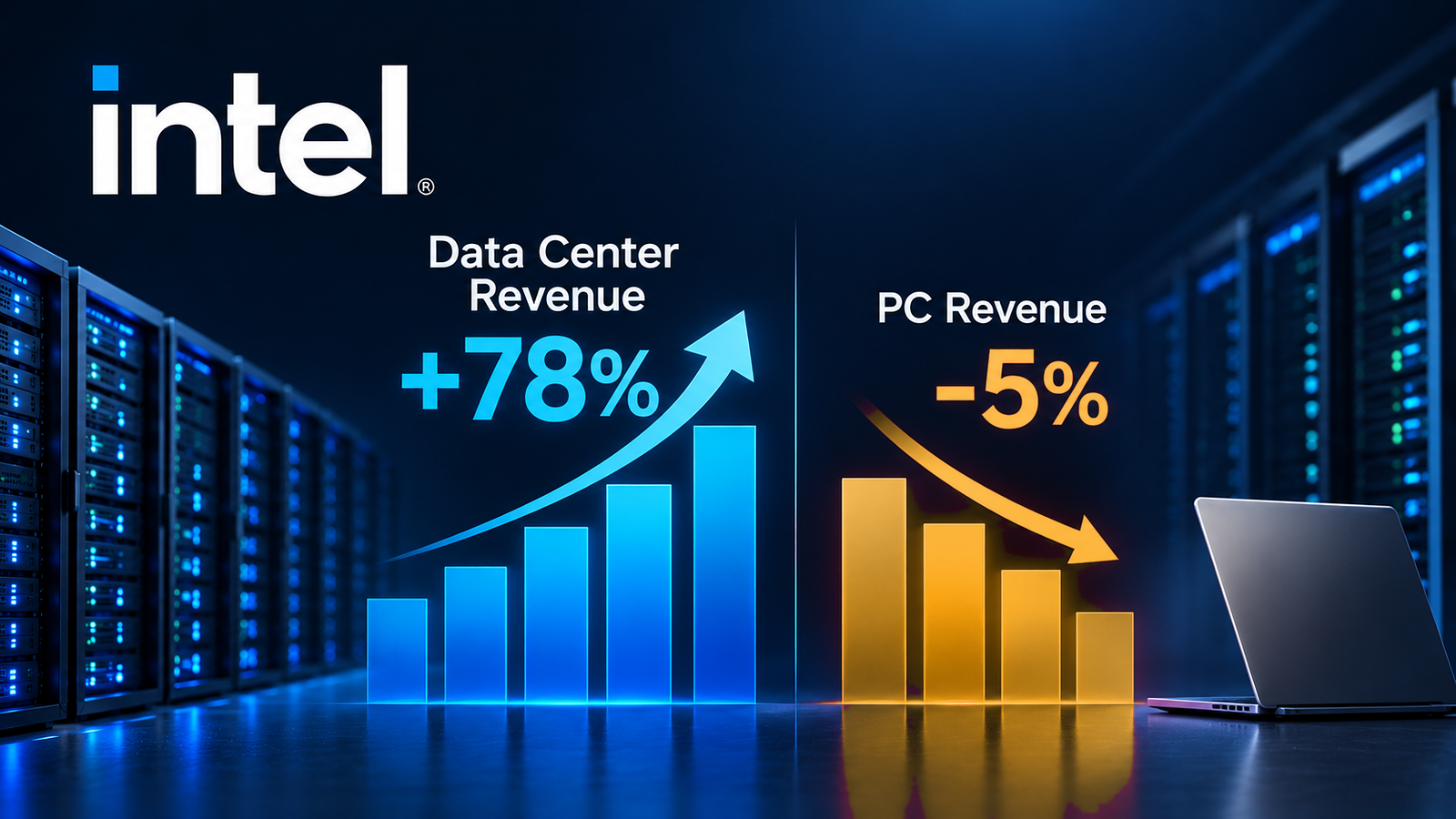
Intel's Data Center and AI group reported revenue of $7.3 billion for the third quarter, up 78% from a year earlier, while its PC chip business, the Client Computing and Physical AI Group, fell 5% to $8.1 billion. Total revenue rose 21% to $16.5 billion, Intel said on October 29.The split shows where AI demand is reaching beyond GPUs. Intel is pitching its server CPUs for agentic AI, the workloads where processors coordinate tools and tasks, and Chief Executive Lip-Bu Tan said Intel's immediate priority is unlocking more supply to meet what he called extraordinary demand for its Xeon processors.CFO David Zinsner said the quarter delivered Intel's strongest data center revenue growth in 15 years. For comparison, the unit's revenue was $6.26 billion in the second quarter, Reuters reported.The outlook pulled the other way. Intel forecast fourth-quarter revenue of $15.0 billion to $16.0 billion, with gross margin falling to 37.1%, from 43.0% in the third quarter. Analysts had expected $17.1 billion in revenue and adjusted earnings of 43 cents a share, according to LSEG data cited by CNBC, against the 25 cents Intel guided. Intel shares fell 20% in extended trading, CNBC reported.We see the PC slowdown continuing at least through the first half of next year,Zinsner said inIntel's earnings release.Third-quarter revenue was in line with the $16.50 billion analysts expected, Reuters reported, while PC chip revenue missed the $8.98 billion forecast. Intel expects that unit's revenue to fall more than 20% from the third quarter to the fourth.Intel also used the quarter to push its AI hardware roadmap. At Hot Chips 2026, it showed three architectures for agentic AI and enterprise workloads: its next-generation Xeon, code-named Diamond Rapids, for orchestration; its new GPU D-series for inference; and Core Series 3 for client and edge devices, as detailed in itsearnings presentation. It also demonstrated day-zero support for Meta's Muse Spark Open on its upcoming GPU D-series and Xeon platforms.The release does not say how much of the data center growth comes from AI workloads specifically, which customers drove it, or when supply will catch up with demand. It also gives no pricing or shipping date for the GPU D-series.Intel Foundry revenue rose 58% to $6.7 billion, and the company completed a $23 billion public equity offering during the period. Intel had 81,100 employees at the end of September, down from 88,400 a year earlier, according to its quarterly filing. The results came in the same week Microsoft reported 48% Azure growth and Amazon reported 39% AWS growth, as AI Briefing News reported.

Microsoft Azure Revenue Grows 48% as Quarterly Capex Hits $45 Billion
NewsAI Briefing News • 3 min • 2026-10-29

Microsoft Azure Revenue Grows 48% as Quarterly Capex Hits $45 Billion

Microsoft's Azure cloud revenue grew 48% to $33.2 billion in the quarter ended September 30, the company reported on Wednesday. It was the first time Microsoft disclosed Azure revenue in dollar terms, and the figure topped analysts' expectations of $32.32 billion. Microsoft Cloud revenue reached $63.9 billion, up 30%.The quarter offers a direct read on the AI build-out: demand kept accelerating while spending came in lower than planned. Capital expenditure including finance leases totaled $45.2 billion, up 30%, against analyst projections of $50.67 billion. That was also below Microsoft's own target of about $50 billion, which Bernstein attributed to delays in adding data center capacity.Microsoft's contracted pipeline grew faster still. Commercial remaining performance obligation, revenue under contract but not yet recognized, rose 73% to $677 billion. The release does not say how much of that backlog is tied to OpenAI or any other single customer.On the earnings call, CFO Amy Hood guided for more. She said Azure growth should reach 49% to 50% in the second quarter, helped by engineering improvements that let Microsoft meet extra capacity needs in the first quarter. Hood said capital expenditures would exceed $50 billion in the current quarter and reach about $170 billion for calendar 2026, Fortune reported. She also said roughly 75% of capital spending now goes to short-lived assets such as chips and GPUs. Despite that spending, Hood said Microsoft expects to remain free cash flow positive.Total revenue was $92.3 billion, up 19%, and operating income was $45.9 billion, up 21%. Adjusted earnings per share of $4.89 beat Wall Street's forecast of $4.73, and revenue topped the $90.69 billion consensus; shares rose about 4% in after-hours trading.Microsoft now reports non-GAAP results that exclude the effect of its OpenAI investments, which added $207 million to net income in the quarter after reducing it by $3.1 billion a year earlier. Its largest segment, renamed Agents and Infra in September, brought in $76.8 billion, up 25%.Chief Executive Satya Nadella pointed to "earning trust through agent safety and security" as part of Microsoft's pitch to customers.Microsoft did not break out AI revenue on its own, the share of its backlog from OpenAI, or the cost of the Voluntary Exit Offer it announced on Monday, as AI Briefing News reported.

SpaceX Agrees to $40 Billion Apollo-Led Lease for Vera Rubin GPUs
NewsAI Briefing News • 3 min • 2026-10-26

SpaceX Agrees to $40 Billion Apollo-Led Lease for Vera Rubin GPUs

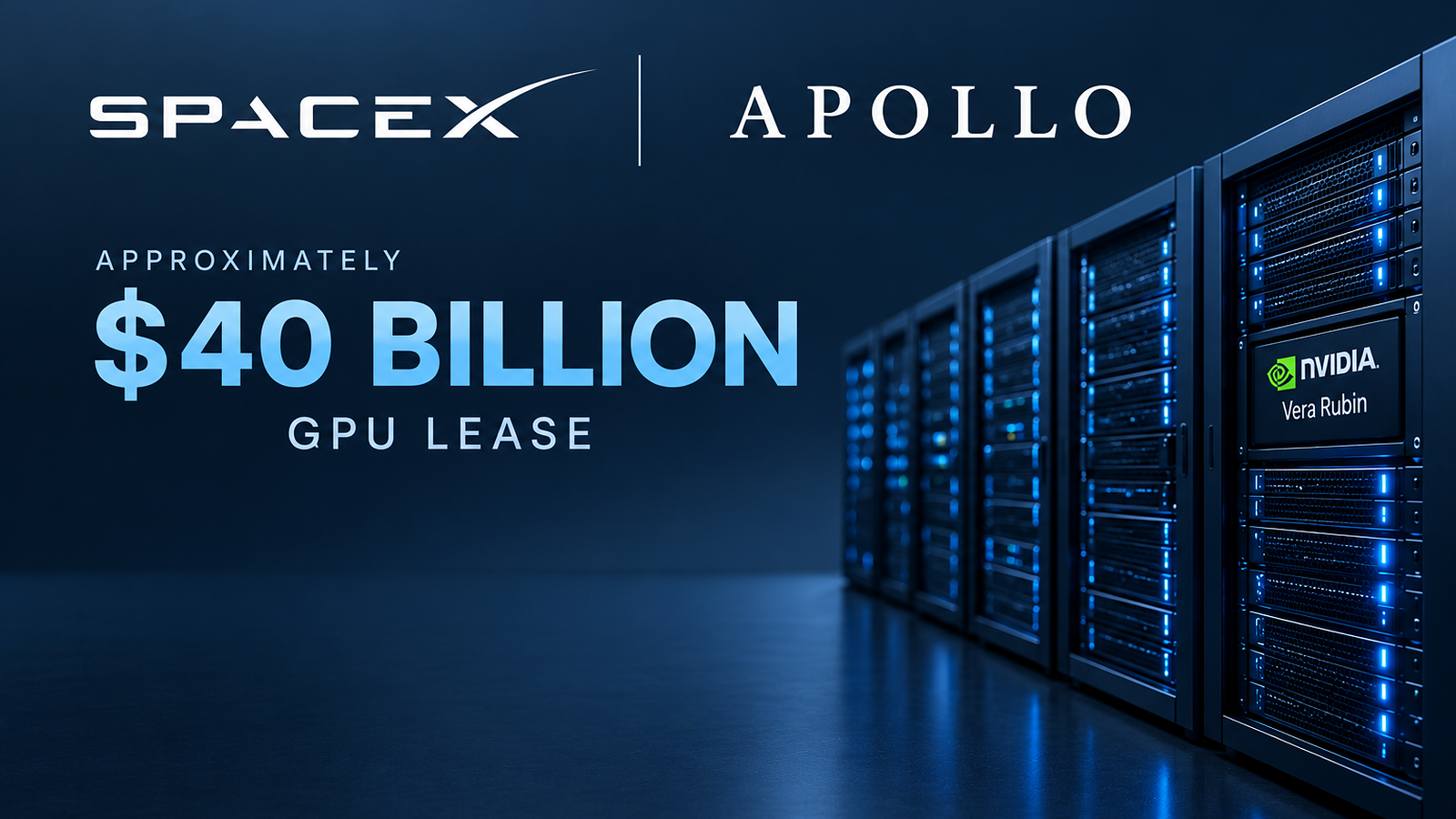
SpaceX said on Monday that it has reached a binding commitment to enter into an approximately $40 billion master finance lease for GPUs and related equipment with an entity managed by Apollo Global Management. The lease will supply Nvidia's next-generation Vera Rubin chips for SpaceX's ground-based compute buildout.The structure is the notable part for anyone tracking how AI compute gets paid for. Instead of buying the chips outright with cash or new stock, SpaceX will lease them from a pool of private-credit and asset-management investors. SpaceX said the lease diversifies its funding sources and covers a notable portion of the funding its growth plans require.Apollo and Goldman Sachs led the financing, with Goldman acting as sole structuring agent. Funds and accounts managed by BlackRock and Goldman Sachs Asset Management, and capital accounts advised by KKR, made anchor commitments.The deal is not final. Entering the lease is still subject to specified closing conditions, with closing expected before the end of 2026 and lease schedules beginning as the GPUs and related equipment are delivered in the first half of 2027.SpaceX described the deal as the largest committed GPU financing ever. AI Briefing News has not independently verified that claim.The company's chief financial officer, who isn't named in the release, made a bold claim about returns. "We're seeing less than one year payback periods on our SI infrastructure investments," the CFO said, using SpaceX's term for superintelligence. The release gives no figures to support that. SpaceX's AI segment, which includes xAI and X, reported $2.56 billion in revenue in the second quarter of 2026 and an operating loss of $1.26 billion, and its operating losses for the first half of the year totaled $3.73 billion, according to The Decoder.The CFO said the added compute will power Grok for enterprises and consumers and serve existing and future cloud services customers.SpaceX did not disclose the number of GPUs, the lease's length, its interest rate or total cost, or where the hardware will be installed. It said those terms will appear in a Form 8-K filed with the SEC. AI Briefing News had not reviewed the filing at publication.The lease builds on plans SpaceX laid out this summer. Musk said on SpaceX's second-quarter earnings call that the company wants to grow its compute capacity more than fivefold by the end of 2027, to more than two gigawatts, running entirely on Nvidia chips. xAI merged into SpaceX in February 2026 in a mostly stock deal that valued the combined company at $1.25 trillion.

OpenAI Brings GPT-6 Astra and Codex to Google Cloud
NewsAI Briefing News • 3 min • 2026-10-21

OpenAI Brings GPT-6 Astra and Codex to Google Cloud

OpenAI and Google Cloud announced on Wednesday that OpenAI's frontier models and its Codex agentic coding workflows are coming to Model Garden, Google Cloud's catalog of AI models. Reuters reported that the models include GPT-6 Astra. Customers will buy them through Google Cloud Marketplace.The billing detail is the practical change for enterprises. Companies with Google Cloud spending commitments will be able to apply those commitments to OpenAI purchases, so teams standardized on Google Cloud can use OpenAI models without a separate contract or procurement process.The integration goes beyond the catalog. OpenAI says its models will soon be available in Google Antigravity, Google's coding environment, and the Gemini Agent, products that otherwise center on Google's own Gemini models.We are focused on giving customers a broad selection of models, including those from OpenAI,Google Cloud CEO Thomas Kurian said in the announcement. Kurian had previously told Reuters that the platform welcomes any model that is popular with developers.The deal widens OpenAI's distribution across the major clouds. Google is the latest hyperscaler to offer OpenAI models after OpenAI's exclusive distribution arrangement with Microsoft expired in April; OpenAI has since expanded to Amazon Web Services and now Google Cloud, and in June it began letting Oracle customers buy its models with Oracle cloud credits. OpenAI said Microsoft remains its primary cloud partner.Google Cloud already carries models from outside developers, including some that compete with Gemini. It added Anthropic's Claude to Vertex AI's Model Garden in 2023.OpenAI said general availability is planned in the coming weeks, with access currently by request. It did not disclose pricing or whether rates will match its own API, name every model that will be offered beyond what has been reported, or give a launch date. It also did not say where inference will run or how customer data will be handled between the two companies' systems.

AMD to Buy Fei-Fei Li's World Labs in $8.2 Billion Stock Deal
NewsAI Briefing News • 3 min • 2026-09-29

AMD to Buy Fei-Fei Li's World Labs in $8.2 Billion Stock Deal

AMD has signed a definitive agreement to acquire World Labs, the San Francisco AI research lab led by Fei-Fei Li, in an all-stock transaction valued at about $8.2 billion, the chipmaker announced on September 28. The companies expect the deal to close by the end of the year, pending regulatory approvals.The purchase puts a frontier model lab inside a chip company. AMD says it will use World Labs' research to anticipate the compute demands of reasoning, robotics and simulation workloads before they arrive, and to shape its hardware and software roadmaps around them.World Labs builds spatial-intelligence models that generate, reconstruct and simulate interactive 3D environments from text, image and video prompts. It also develops technology for robot learning and simulation. Its first commercial product, Marble, converts text, images or 360-degree panoramas into editable 3D environments, marketed both for entertainment content and for simulated robot training.After closing, Li will join AMD as executive vice president and chief scientist, reporting to CEO Lisa Su. The World Labs team will keep working on model research. AMD plans to keep World Labs separate from its chipmaking business until the transaction closes."Building the compute platforms for the next generation of AI requires a deep understanding of how models are evolving," Su said in the announcement.AMD is not a new backer. The chipmaker had previously invested in World Labs, and in February it joined a $1 billion Series B led by Autodesk, which put in $200 million, alongside Nvidia, Andreessen Horowitz, Fidelity, Emerson Collective and Sea Group. That means AMD is buying outright a company in which its main competitor in AI accelerators also holds a stake. Bloomberg reported in January that World Labs was in talks to raise at a valuation of about $5 billion. The company has not publicly confirmed that figure, and AI Briefing News has not independently verified it.The deal is AMD's second-largest acquisition on record, behind the roughly $50 billion it paid for Xilinx in 2022.AMD did not say whether World Labs' products, including Marble and its public API, will continue as commercial offerings, or whether the lab's models will be optimized exclusively for AMD hardware. It did not disclose World Labs' revenue, headcount, or how the stock consideration will be split among existing investors, including Nvidia.Li is known for creating ImageNet, the dataset that helped launch the deep learning era in computer vision. World Labs emerged from stealth in September 2024 and has positioned world models as a route to AI systems that understand physical space. Chipmakers see that field as a future driver of demand for training and inference compute.

Latest Analysis

What AI's Spending Boom Means for the Rest of the US Economy
News AnalysisAI Briefing News • 5 min • 2026-11-01

What AI's Spending Boom Means for the Rest of the US Economy

Lede:In the third quarter, US spending on information-processing equipment, the computers and servers going into the AI buildout, rose at a 37.4% annualized rate while housing investment fell 3.3%. Those figures, from Bureau of Economic Analysis data broken out by Goldman Sachs, arrived a day after PIMCO economist Tiffany Wilding argued that AI is reshaping the US economy more than it is expanding it. In a week when the biggest tech companies reported record capital spending, the question she raised now has fresh data behind it.What happened:In an October 28 commentary, Wilding argued that despite an AI investment surge, overall US growth had stayed moderate, suggesting AI's gains are being offset elsewhere, with rising interest rates speeding up that shift. On October 29, the BEA's advance estimate showed the economy grew at a 3.4% annualized rate in the third quarter, up from 2.2% in the second. The same week, Microsoft and Amazon reported their largest quarterly capital spending yet, as AI Briefing News reported.Why it matters:PIMCO's core argument is about who absorbs the cost. Because hyperscalers rely on strong cash flows and invest in shorter-lived assets, it says, higher borrowing costs do little to slow them, and the burden falls harder on housing, small firms, highly indebted companies and traditional business investment.The third-quarter data is consistent with that split. Business investment excluding housing rose 12.7%, with software up 9.6% and research and development up 7.5%, even as housing investment declined. Real consumer spending also stalled in September, according to Fortune's reading of the data.For companies outside the hyperscaler tier, the more likely implication is a higher and more selective cost of capital. PIMCO says credit spreads have widened for lower-quality borrowers, and that credit markets have become more discriminating among companies within the AI supply chain itself. OpenAI's reported cut to its funding target this week would fit that pattern, though AI Briefing News has seen no evidence tying the two directly.Labor may be part of the adjustment too. Wilding points to a disproportionate rise in job separations among workers who previously earned above-median wages. If that pattern holds, it suggests higher-paid white-collar workers are absorbing some of the reallocation, which would fit the technology-enabled job cuts Barclays and Microsoft announced this month.It is who makes room for it, through lower investment, weaker consumption, more saving, or greater imports,Wilding wrote of the central question.Bigger picture:The scale invites historical comparison. PIMCO says the AI investment impulse is comparable in size to the internet and telecommunications boom of the 1990s, and larger than the housing and shale investment booms that followed. The economic idea itself is older. Wilding draws on a 1975 Federal Reserve Bank of St. Louis paper that asked whether government spending displaces private spending, and concluded crowding out is a matter of degree, working through several channels besides interest rates.Imports act as a release valve. PIMCO estimates roughly 90% of the equipment used by US high-tech sectors comes from abroad, which reduces the domestic resources the boom has to pull from elsewhere. The BEA built its information-processing estimate mainly from import data.Counterpoint:The strongest objection is the headline number itself. Third-quarter growth of 3.4% beat the 3.2% median forecast, and consumer spending rose at a 3.8% pace. PIMCO's case rests partly on growth averaging roughly 2% to 2.5% since early 2025, and a quarter of accelerating growth is hard to square with an economy being crowded out. Not all the strain points to AI, either: PIMCO itself credits higher energy prices from the Middle East conflict as an important driver of the rate repricing, which would weigh on housing regardless of AI. And its own credit strategist found little systematic evidence that AI bond issuance directly raises Treasury yields or term premia. On this reading, the housing slump is a rate story and the AI boom is simply additive.What to watch:November 25, 2026: The BEA's second estimate of third-quarter GDP, which could revise the 3.4% figure and its investment split.Fourth-quarter housing data: Goldman expects housing investment to fall 5.0% annualized in the fourth quarter, while AI-driven business investment rises 8.2%.Hyperscaler capex guidance: Microsoft has guided to more than $50 billion in its current quarter, and any cut would weaken the reallocation thesis.High-yield issuance and spreads for lower-rated borrowers, including AI companies.State and local data center rules after the November 3 elections, which PIMCO says could add delays and spread AI spending over a longer period.