Wednesday, November 4, 2026

AI Briefing News

STARTUPS & FUNDING CATEGORY

Startups & Funding

Track funding and company formation across the AI startup market. This section covers venture rounds, valuations, acquisitions, product launches and the investors backing them. We report confirmed terms and name our source, and we say clearly when a round is announced without disclosed figures.

Funding flows, market structure shifts, and competitive movement.

Marvell to Buy Lumentum in $115 Billion All-Stock AI Optics Deal

Marvell to Buy Lumentum in $115 Billion All-Stock AI Optics Deal

Marvell Technology and Lumentum said on Monday that they had signed a definitive agreement for Marvell to acquire Lumentum in an all-stock transaction, with Lumentum shareholders receiving 4.5 Marvell shares for each Lumentum share they own. The deal implies an enterprise value of $115 billion for Lumentum, or about $1,132 a share, a premium of roughly 23.9% based on each company's closing share price on October 28, the last trading day before market speculation about a deal began. Reuters put the equity value at $102.54 billion.The deal combines the electrical and optical sides of the networking that links AI chips inside data centers. Marvell brings electrical and optical interconnect, network switching and custom chip technology, while Lumentum adds high-performance lasers, optical transceivers, optical circuit switching and compound semiconductor manufacturing.AI infrastructure is undergoing a fundamental architectural shift toward optical connectivity,Marvell Chief Executive Matt Murphy said.After closing, Marvell shareholders will own about 67% of the combined company and Lumentum shareholders about 33%. Murphy will remain chairman and CEO, and three Lumentum directors, including CEO Michael Hurlston, will join Marvell's seven-member board.The headline value is already out of date. Because Lumentum shareholders receive a fixed number of Marvell shares, the deal's value moves with Marvell's stock. Since talks were first reported in late October, Lumentum's shares have fallen about 8% and Marvell's about 22%, amid a chip selloff that accelerated after Intel's weak forecast, Reuters reported. Marvell's shares rose 2.8% in premarket trading on Monday, while trading in Lumentum was halted.The companies said the combination would expand their total addressable market to $550 billion, and that they see a path to more than $1 billion in annual run-rate cost synergies, with the deal adding to Marvell's non-GAAP earnings per share in its first year. Those are the companies' own estimates.The deal is subject to approval by both companies' shareholders, regulatory approvals and other customary conditions. The companies did not say which regulators must approve it, whether there is a breakup fee, how much of the cost savings would come from job cuts, or which customers the combined company serves.Nvidia invested $2 billion each in Marvell and Lumentum earlier this year. In August, Marvell signed a deal to supply chips that work alongside Google's AI processors, worth up to $120 billion in sales through fiscal 2033. The acquisition is Marvell's largest since its $10 billion purchase of Inphi in 2021.

AI Briefing News • 3 min • 2026-11-02

Latest Category News

OpenAI Cuts Funding Round Target to $20 Billion, FT Reports
NewsAI Briefing News • 3 min • 2026-10-31

OpenAI Cuts Funding Round Target to $20 Billion, FT Reports

OpenAI has cut the target for its latest funding round by $10 billion, to about $20 billion, the Financial Times reported, and set Friday, October 30, as the deadline for investors to commit, with a first close likely to raise less than $20 billion. The Wall Street Journal separately reported that OpenAI had secured roughly $11 billion in commitments, less than half of its initial $30 billion target.The shortfall is a rare sign of investor caution toward the most valuable private AI company, in a week when AI stocks fell and spending on AI infrastructure came under fresh scrutiny.According to the reports, OpenAI also lowered the valuation it is seeking to $1.25 trillion, from $1.4 trillion. Some investors reduced their commitments as AI stocks fell, according to the FT. The reports linked the cuts to a tech-stock sell-off and concern about AI spending.The two figures measure different things. The FT's $20 billion is the revised target, while the Journal's $11 billion reflects commitments secured so far, so the round could still grow before it closes.CNBC previously reported that investors from the United Arab Emirates and the investment firm Coatue were leading the round.OpenAI has not announced the round or confirmed any of the reported figures. AI Briefing News has not independently verified the reports and has asked OpenAI for comment.The reports don't say when the round will close, how much each investor has committed, or whether OpenAI will keep raising after a first close. The FT report did not explain why OpenAI revised its target or name the investors involved.Bloomberg News reported in late September that OpenAI aimed to raise at least $30 billion at a valuation of about $1.4 trillion, excluding the new money. Reuters reported at the time that OpenAI's annualized revenue run rate was nearing $70 billion, up more than 70% since the start of the third quarter. OpenAI's previous round, announced on March 31, raised $122 billion in committed capital at an $852 billion post-money valuation. The new round comes as rival Anthropic prepares for a public listing after filing its S-1 on October 26, as AI Briefing News reported.

Canada to Take Up to C$1.6 Billion Equity Stake in AI Firm Cohere
NewsAI Briefing News • 3 min • 2026-10-30

Canada to Take Up to C$1.6 Billion Equity Stake in AI Firm Cohere

Prime Minister Mark Carney announced on Thursday that Canada's federal government will make an equity investment of up to C$1.6 billion in Cohere, the Toronto-based enterprise AI company, alongside private investors including Nvidia, Bell and Germany's Schwarz Group. According to thegovernment's announcement , it is a commercial investment that will be made in stages, with consistent reporting regularly on its progress.The deal puts the government on Cohere's cap table, not just in its customer list. Cohere is raising up to C$7 billion in new funding, including the federal investment,The Logic reported , with Schwarz Group leading the round. Cohere put the round's valuation at C$35.7 billion, up from about $7 billion in September 2025, according to Bloomberg Law. Bloomberg put the federal investment at up to US$1.14 billion, as The Next Web reported .In return, Cohere has made several commitments, according to the government. It will create at least 1,000 high-paying technical jobs in Canada and invest at least C$1.7 billion in Canadian computing infrastructure, both by 2030. It will also maintain its Canadian incorporation and headquarters, fund research partnerships, and continue working with the Canadian AI Safety Institute.Canada's investment in Cohere is an investment in choice, in security, and in our ability to live our lives as we choose,Carney said.The money will come through the Canada Development Investment Corporation, a Crown corporation that manages assets for the government, AI Minister Evan Solomon told BetaKit . Carney made the announcement on the first day of the Canada-European Union Summit.According to Cohere's release , Bell Ventures, Bullhound Capital and the Government of Canada are new investors, while Inovia Capital, Nvidia and Prosperity7 Ventures are returning. Cohere said its customer count grew 20-fold over the last year to 300, including Bell Canada, Fujitsu, RBC and TD Bank. The company also said its annual recurring revenue grew more than 165% in the year to the end of September, but it did not disclose a revenue figure. AI Briefing News has not independently verified Cohere's growth claims.Neither the government nor Cohere said what percentage of the company Canada will own, how much each investor is contributing, how much Cohere has raised so far, or what happens if Cohere misses its commitments. The government also did not publish the schedule for its staged payments.Cohere announced in April that it would merge with Germany's Aleph Alpha, and Carney described the partnership as a concrete example of what Canada and Europe can build together, Global News reported .

SpaceX Agrees to $40 Billion Apollo-Led Lease for Vera Rubin GPUs
NewsAI Briefing News • 3 min • 2026-10-26

SpaceX Agrees to $40 Billion Apollo-Led Lease for Vera Rubin GPUs

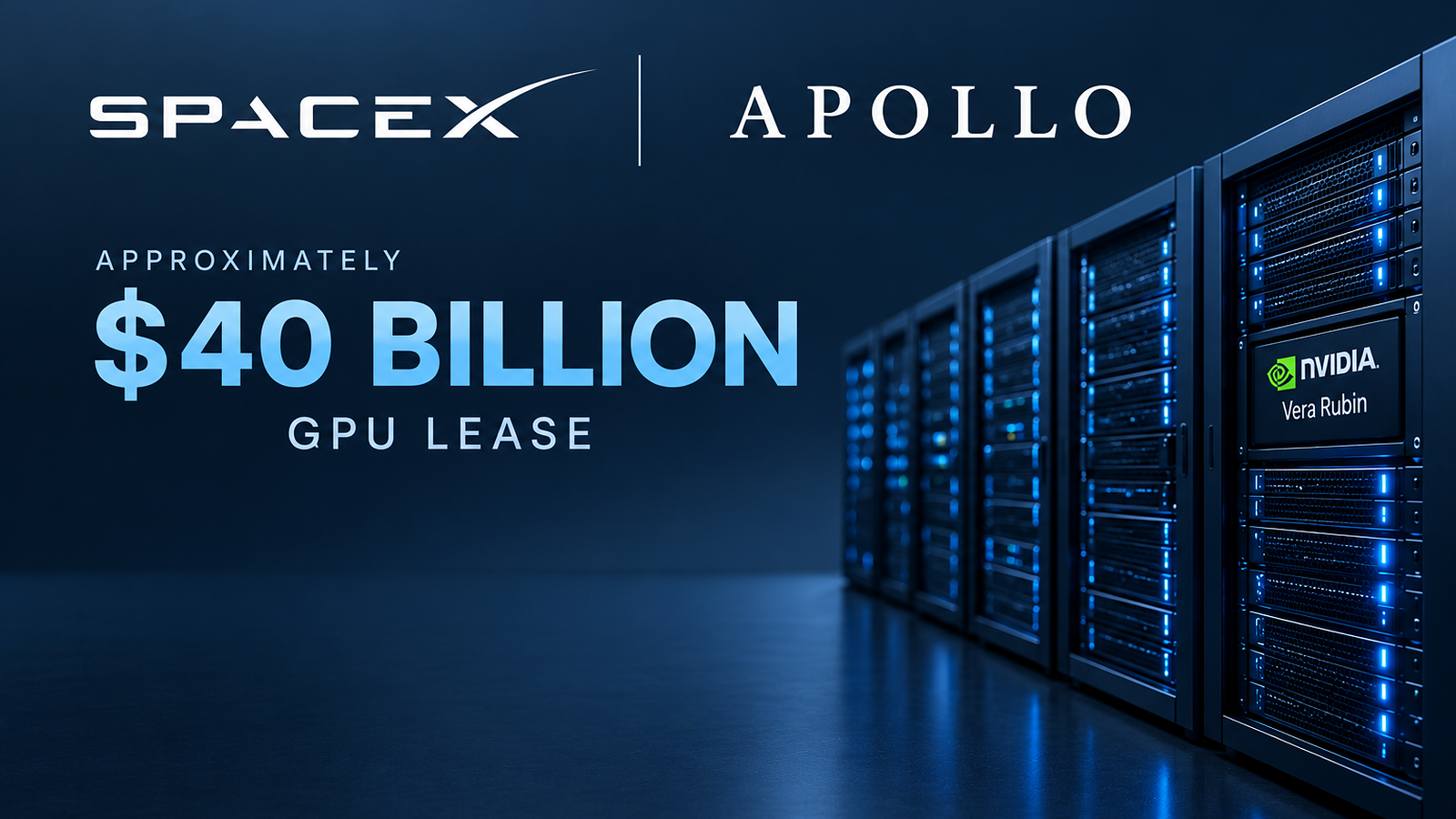
SpaceX said on Monday that it has reached a binding commitment to enter into an approximately $40 billion master finance lease for GPUs and related equipment with an entity managed by Apollo Global Management. The lease will supply Nvidia's next-generation Vera Rubin chips for SpaceX's ground-based compute buildout.The structure is the notable part for anyone tracking how AI compute gets paid for. Instead of buying the chips outright with cash or new stock, SpaceX will lease them from a pool of private-credit and asset-management investors. SpaceX said the lease diversifies its funding sources and covers a notable portion of the funding its growth plans require.Apollo and Goldman Sachs led the financing, with Goldman acting as sole structuring agent. Funds and accounts managed by BlackRock and Goldman Sachs Asset Management, and capital accounts advised by KKR, made anchor commitments.The deal is not final. Entering the lease is still subject to specified closing conditions, with closing expected before the end of 2026 and lease schedules beginning as the GPUs and related equipment are delivered in the first half of 2027.SpaceX described the deal as the largest committed GPU financing ever. AI Briefing News has not independently verified that claim.The company's chief financial officer, who isn't named in the release, made a bold claim about returns. "We're seeing less than one year payback periods on our SI infrastructure investments," the CFO said, using SpaceX's term for superintelligence. The release gives no figures to support that. SpaceX's AI segment, which includes xAI and X, reported $2.56 billion in revenue in the second quarter of 2026 and an operating loss of $1.26 billion, and its operating losses for the first half of the year totaled $3.73 billion, according to The Decoder.The CFO said the added compute will power Grok for enterprises and consumers and serve existing and future cloud services customers.SpaceX did not disclose the number of GPUs, the lease's length, its interest rate or total cost, or where the hardware will be installed. It said those terms will appear in a Form 8-K filed with the SEC. AI Briefing News had not reviewed the filing at publication.The lease builds on plans SpaceX laid out this summer. Musk said on SpaceX's second-quarter earnings call that the company wants to grow its compute capacity more than fivefold by the end of 2027, to more than two gigawatts, running entirely on Nvidia chips. xAI merged into SpaceX in February 2026 in a mostly stock deal that valued the combined company at $1.25 trillion.

Anthropic Files for IPO, Posts $16.3 Billion in First-Half Revenue
NewsAI Briefing News • 3 min • 2026-10-26

Anthropic Files for IPO, Posts $16.3 Billion in First-Half Revenue

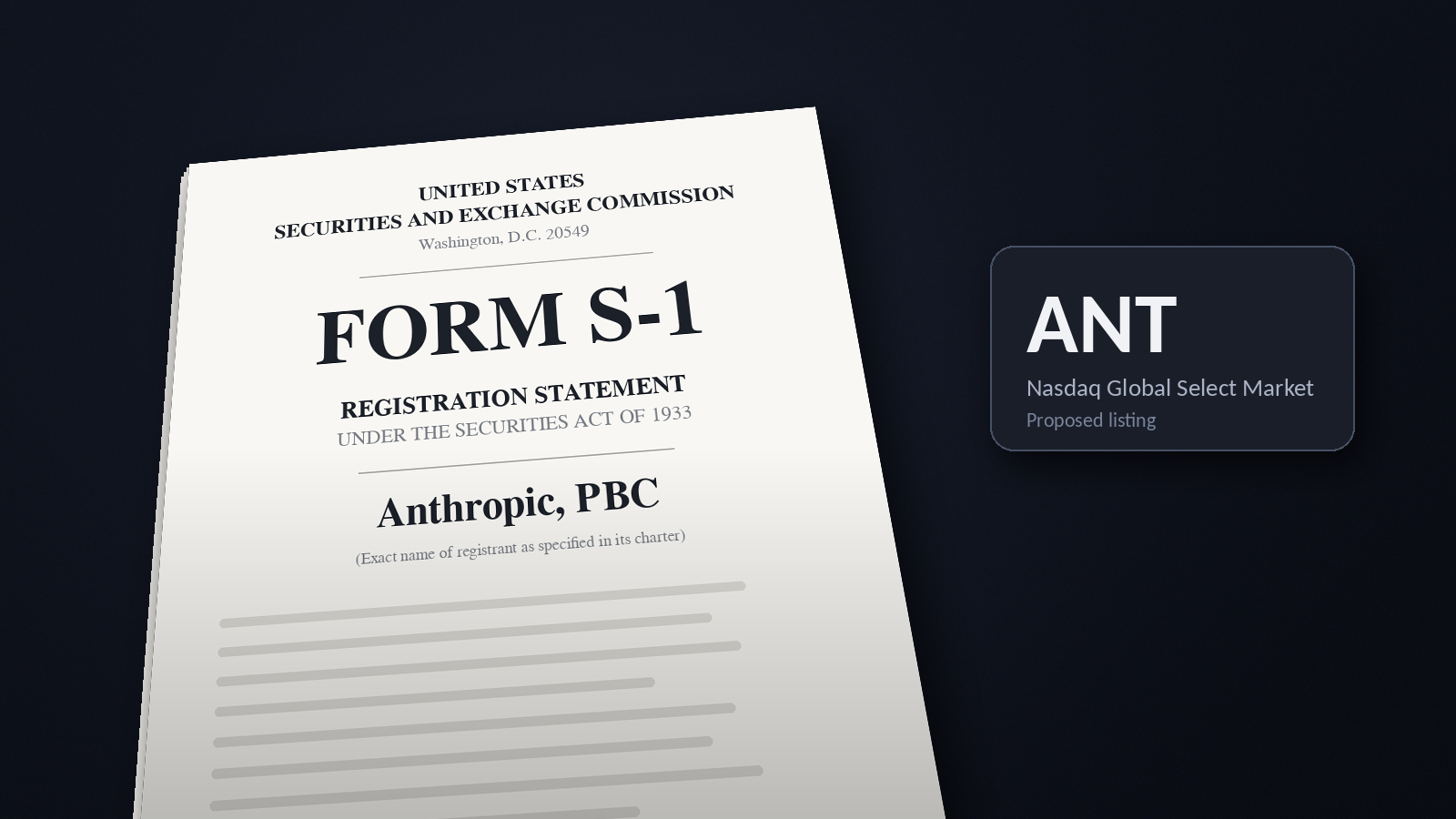
Anthropic, PBC, filed a registration statement on Form S-1 with the Securities and Exchange Commission on Monday for a proposed initial public offering of its Class A common stock. The company intends to list on the Nasdaq Global Select Market under the symbol "ANT," and has not yet set the number of shares or the price range.The filing is the first official look at the finances of one of the largest private AI developers. It shows revenue of $16,286 million for the six months ended June 30, 2026, compared with $1,163 million for the same period of 2025, and $4,585 million for all of 2025. Annual revenue was $41 million in 2023 and $386 million in 2024.The headline loss looks very different depending on which line is read. The operating loss for the first half of 2026 was $693 million, down from $2,135 million a year earlier, while the net loss for the half was $80,748 million. Yahoo Finance reported that the vast majority of the net loss came from accounting charges. According to a summary of the filing, $72.4 billion of the first-half loss reflects changes in the fair value of convertible notes, derivative liabilities and SAFEs, which rise as the company's valuation increases. AI Briefing News has not independently verified that breakdown against the filing.For 2025, Anthropic reported a net loss of $41,965 million on an operating loss of $8,060 million. The company spent $9 billion on AI infrastructure in the first six months of 2026, compared with $7.3 billion in all of 2025, according to Yahoo Finance.Goldman Sachs and Morgan Stanley are listed as the contacts for the preliminary prospectus, and the registration statement has not yet become effective.The preliminary filing leaves several key figures blank. It doesn't give the offering size, share count, price range or a target valuation. It also leaves blank Anthropic's revenue for the three months ended September 30, 2026. And it doesn't break out revenue by product, so it doesn't show how much comes from the API, subscriptions or Claude Code. Those details typically appear in amended filings ahead of pricing.Anthropic confidentially submitted a draft S-1 in June. The public filing confirms figures first reported from a leaked draft prospectus in late September, including the company's $42 billion loss and $4.6 billion in revenue for 2025.

AMD to Buy Fei-Fei Li's World Labs in $8.2 Billion Stock Deal
NewsAI Briefing News • 3 min • 2026-09-29

AMD to Buy Fei-Fei Li's World Labs in $8.2 Billion Stock Deal

AMD has signed a definitive agreement to acquire World Labs, the San Francisco AI research lab led by Fei-Fei Li, in an all-stock transaction valued at about $8.2 billion, the chipmaker announced on September 28. The companies expect the deal to close by the end of the year, pending regulatory approvals.The purchase puts a frontier model lab inside a chip company. AMD says it will use World Labs' research to anticipate the compute demands of reasoning, robotics and simulation workloads before they arrive, and to shape its hardware and software roadmaps around them.World Labs builds spatial-intelligence models that generate, reconstruct and simulate interactive 3D environments from text, image and video prompts. It also develops technology for robot learning and simulation. Its first commercial product, Marble, converts text, images or 360-degree panoramas into editable 3D environments, marketed both for entertainment content and for simulated robot training.After closing, Li will join AMD as executive vice president and chief scientist, reporting to CEO Lisa Su. The World Labs team will keep working on model research. AMD plans to keep World Labs separate from its chipmaking business until the transaction closes."Building the compute platforms for the next generation of AI requires a deep understanding of how models are evolving," Su said in the announcement.AMD is not a new backer. The chipmaker had previously invested in World Labs, and in February it joined a $1 billion Series B led by Autodesk, which put in $200 million, alongside Nvidia, Andreessen Horowitz, Fidelity, Emerson Collective and Sea Group. That means AMD is buying outright a company in which its main competitor in AI accelerators also holds a stake. Bloomberg reported in January that World Labs was in talks to raise at a valuation of about $5 billion. The company has not publicly confirmed that figure, and AI Briefing News has not independently verified it.The deal is AMD's second-largest acquisition on record, behind the roughly $50 billion it paid for Xilinx in 2022.AMD did not say whether World Labs' products, including Marble and its public API, will continue as commercial offerings, or whether the lab's models will be optimized exclusively for AMD hardware. It did not disclose World Labs' revenue, headcount, or how the stock consideration will be split among existing investors, including Nvidia.Li is known for creating ImageNet, the dataset that helped launch the deep learning era in computer vision. World Labs emerged from stealth in September 2024 and has positioned world models as a route to AI systems that understand physical space. Chipmakers see that field as a future driver of demand for training and inference compute.