Tuesday, November 3, 2026

AI Briefing News

Search results for “all topics”

High-signal AI coverage ranked by relevance and recency.

Marvell to Buy Lumentum in $115 Billion All-Stock AI Optics Deal
News3 min • 2026-11-02

Marvell to Buy Lumentum in $115 Billion All-Stock AI Optics Deal

Marvell Technology and Lumentum said on Monday that they had signed a definitive agreement for Marvell to acquire Lumentum in an all-stock transaction, with Lumentum shareholders receiving 4.5 Marvell shares for each Lumentum share they own. The deal implies an enterprise value of $115 billion for Lumentum, or about $1,132 a share, a premium of roughly 23.9% based on each company's closing share price on October 28, the last trading day before market speculation about a deal began. Reuters put the equity value at $102.54 billion.The deal combines the electrical and optical sides of the networking that links AI chips inside data centers. Marvell brings electrical and optical interconnect, network switching and custom chip technology, while Lumentum adds high-performance lasers, optical transceivers, optical circuit switching and compound semiconductor manufacturing.AI infrastructure is undergoing a fundamental architectural shift toward optical connectivity,Marvell Chief Executive Matt Murphy said.After closing, Marvell shareholders will own about 67% of the combined company and Lumentum shareholders about 33%. Murphy will remain chairman and CEO, and three Lumentum directors, including CEO Michael Hurlston, will join Marvell's seven-member board.The headline value is already out of date. Because Lumentum shareholders receive a fixed number of Marvell shares, the deal's value moves with Marvell's stock. Since talks were first reported in late October, Lumentum's shares have fallen about 8% and Marvell's about 22%, amid a chip selloff that accelerated after Intel's weak forecast, Reuters reported. Marvell's shares rose 2.8% in premarket trading on Monday, while trading in Lumentum was halted.The companies said the combination would expand their total addressable market to $550 billion, and that they see a path to more than $1 billion in annual run-rate cost synergies, with the deal adding to Marvell's non-GAAP earnings per share in its first year. Those are the companies' own estimates.The deal is subject to approval by both companies' shareholders, regulatory approvals and other customary conditions. The companies did not say which regulators must approve it, whether there is a breakup fee, how much of the cost savings would come from job cuts, or which customers the combined company serves.Nvidia invested $2 billion each in Marvell and Lumentum earlier this year. In August, Marvell signed a deal to supply chips that work alongside Google's AI processors, worth up to $120 billion in sales through fiscal 2033. The acquisition is Marvell's largest since its $10 billion purchase of Inphi in 2021.

ADNOC Signs Deal to Deploy OpenAI's Frontier Agents With G42
News3 min • 2026-11-02

ADNOC Signs Deal to Deploy OpenAI's Frontier Agents With G42

Abu Dhabi National Oil Co.on Monday signed an agreement with OpenAI and G42 under which it says it will become the first energy company to deploy OpenAI's Frontier technology, with G42 taking part through its subsidiary Inception42. The system will run on OpenAI's GPT models using inference infrastructure located in the UAE.The agreement moves OpenAI's agent platform into heavy industry, where it will draw on an oil company's operational data rather than office documents. Under the partnership, OpenAI's models will be paired with ADNOC's industrial data to build AI systems for different parts of the company.The multiyear partnership aims to link field development planning with operational and commercial decisions across ADNOC's energy business. The first planned use is field master planning, Gulf News reported, describing Frontier as a system for coordinating AI agents across different business functions. The agreement also covers cybersecurity work through OpenAI's Daybreak Blue programme and training for ADNOC employees.The agreement was signed at ADIPEC, the energy conference in Abu Dhabi, after Sheikh Khaled bin Mohamed bin Zayed, the Crown Prince of Abu Dhabi, met OpenAI Chief Executive Sam Altman, according to The National.The ADNOC deal was one of four agreements involving Abu Dhabi organizations that OpenAI announced on Monday. Mubadala, Inception42 and OpenAI agreed to apply AI to investment analysis, finding opportunities and assessing risk, and Inception42 and OpenAI signed a five-year agreement to support frontier AI adoption across UAE government, business and education.The companies did not disclose the value of any of the agreements, how long the ADNOC partnership runs, or who will operate the UAE-based inference infrastructure. They also did not explain the basis for describing ADNOC as the first energy company to use Frontier, or give details of the Daybreak Blue cybersecurity work.ADNOC has worked with OpenAI's models before. In November 2024, it described plans to use its ENERGYai system for seismic interpretation, more efficient energy use and real-time process monitoring, without naming the OpenAI models involved. AIQ, which built ENERGYai with G42 and Microsoft, later valued a three-year agreement with ADNOC at $340 million. UAE investors are also among those reported to be leading OpenAI's current funding round, as AI Briefing News reported last week.

What AI's Spending Boom Means for the Rest of the US Economy
News Analysis5 min • 2026-11-01

What AI's Spending Boom Means for the Rest of the US Economy

Lede:In the third quarter, US spending on information-processing equipment, the computers and servers going into the AI buildout, rose at a 37.4% annualized rate while housing investment fell 3.3%. Those figures, from Bureau of Economic Analysis data broken out by Goldman Sachs, arrived a day after PIMCO economist Tiffany Wilding argued that AI is reshaping the US economy more than it is expanding it. In a week when the biggest tech companies reported record capital spending, the question she raised now has fresh data behind it.What happened:In an October 28 commentary, Wilding argued that despite an AI investment surge, overall US growth had stayed moderate, suggesting AI's gains are being offset elsewhere, with rising interest rates speeding up that shift. On October 29, the BEA's advance estimate showed the economy grew at a 3.4% annualized rate in the third quarter, up from 2.2% in the second. The same week, Microsoft and Amazon reported their largest quarterly capital spending yet, as AI Briefing News reported.Why it matters:PIMCO's core argument is about who absorbs the cost. Because hyperscalers rely on strong cash flows and invest in shorter-lived assets, it says, higher borrowing costs do little to slow them, and the burden falls harder on housing, small firms, highly indebted companies and traditional business investment.The third-quarter data is consistent with that split. Business investment excluding housing rose 12.7%, with software up 9.6% and research and development up 7.5%, even as housing investment declined. Real consumer spending also stalled in September, according to Fortune's reading of the data.For companies outside the hyperscaler tier, the more likely implication is a higher and more selective cost of capital. PIMCO says credit spreads have widened for lower-quality borrowers, and that credit markets have become more discriminating among companies within the AI supply chain itself. OpenAI's reported cut to its funding target this week would fit that pattern, though AI Briefing News has seen no evidence tying the two directly.Labor may be part of the adjustment too. Wilding points to a disproportionate rise in job separations among workers who previously earned above-median wages. If that pattern holds, it suggests higher-paid white-collar workers are absorbing some of the reallocation, which would fit the technology-enabled job cuts Barclays and Microsoft announced this month.It is who makes room for it, through lower investment, weaker consumption, more saving, or greater imports,Wilding wrote of the central question.Bigger picture:The scale invites historical comparison. PIMCO says the AI investment impulse is comparable in size to the internet and telecommunications boom of the 1990s, and larger than the housing and shale investment booms that followed. The economic idea itself is older. Wilding draws on a 1975 Federal Reserve Bank of St. Louis paper that asked whether government spending displaces private spending, and concluded crowding out is a matter of degree, working through several channels besides interest rates.Imports act as a release valve. PIMCO estimates roughly 90% of the equipment used by US high-tech sectors comes from abroad, which reduces the domestic resources the boom has to pull from elsewhere. The BEA built its information-processing estimate mainly from import data.Counterpoint:The strongest objection is the headline number itself. Third-quarter growth of 3.4% beat the 3.2% median forecast, and consumer spending rose at a 3.8% pace. PIMCO's case rests partly on growth averaging roughly 2% to 2.5% since early 2025, and a quarter of accelerating growth is hard to square with an economy being crowded out. Not all the strain points to AI, either: PIMCO itself credits higher energy prices from the Middle East conflict as an important driver of the rate repricing, which would weigh on housing regardless of AI. And its own credit strategist found little systematic evidence that AI bond issuance directly raises Treasury yields or term premia. On this reading, the housing slump is a rate story and the AI boom is simply additive.What to watch:November 25, 2026: The BEA's second estimate of third-quarter GDP, which could revise the 3.4% figure and its investment split.Fourth-quarter housing data: Goldman expects housing investment to fall 5.0% annualized in the fourth quarter, while AI-driven business investment rises 8.2%.Hyperscaler capex guidance: Microsoft has guided to more than $50 billion in its current quarter, and any cut would weaken the reallocation thesis.High-yield issuance and spreads for lower-rated borrowers, including AI companies.State and local data center rules after the November 3 elections, which PIMCO says could add delays and spread AI spending over a longer period.

Intel's Data Center Revenue Jumps 78% as PC Slump Hits Forecast
News3 min • 2026-10-31

Intel's Data Center Revenue Jumps 78% as PC Slump Hits Forecast

Intel's Data Center and AI group reported revenue of $7.3 billion for the third quarter, up 78% from a year earlier, while its PC chip business, the Client Computing and Physical AI Group, fell 5% to $8.1 billion. Total revenue rose 21% to $16.5 billion, Intel said on October 29.The split shows where AI demand is reaching beyond GPUs. Intel is pitching its server CPUs for agentic AI, the workloads where processors coordinate tools and tasks, and Chief Executive Lip-Bu Tan said Intel's immediate priority is unlocking more supply to meet what he called extraordinary demand for its Xeon processors.CFO David Zinsner said the quarter delivered Intel's strongest data center revenue growth in 15 years. For comparison, the unit's revenue was $6.26 billion in the second quarter, Reuters reported.The outlook pulled the other way. Intel forecast fourth-quarter revenue of $15.0 billion to $16.0 billion, with gross margin falling to 37.1%, from 43.0% in the third quarter. Analysts had expected $17.1 billion in revenue and adjusted earnings of 43 cents a share, according to LSEG data cited by CNBC, against the 25 cents Intel guided. Intel shares fell 20% in extended trading, CNBC reported.We see the PC slowdown continuing at least through the first half of next year,Zinsner said inIntel's earnings release.Third-quarter revenue was in line with the $16.50 billion analysts expected, Reuters reported, while PC chip revenue missed the $8.98 billion forecast. Intel expects that unit's revenue to fall more than 20% from the third quarter to the fourth.Intel also used the quarter to push its AI hardware roadmap. At Hot Chips 2026, it showed three architectures for agentic AI and enterprise workloads: its next-generation Xeon, code-named Diamond Rapids, for orchestration; its new GPU D-series for inference; and Core Series 3 for client and edge devices, as detailed in itsearnings presentation. It also demonstrated day-zero support for Meta's Muse Spark Open on its upcoming GPU D-series and Xeon platforms.The release does not say how much of the data center growth comes from AI workloads specifically, which customers drove it, or when supply will catch up with demand. It also gives no pricing or shipping date for the GPU D-series.Intel Foundry revenue rose 58% to $6.7 billion, and the company completed a $23 billion public equity offering during the period. Intel had 81,100 employees at the end of September, down from 88,400 a year earlier, according to its quarterly filing. The results came in the same week Microsoft reported 48% Azure growth and Amazon reported 39% AWS growth, as AI Briefing News reported.

OpenAI Cuts Funding Round Target to $20 Billion, FT Reports
News3 min • 2026-10-31

OpenAI Cuts Funding Round Target to $20 Billion, FT Reports

OpenAI has cut the target for its latest funding round by $10 billion, to about $20 billion, the Financial Times reported, and set Friday, October 30, as the deadline for investors to commit, with a first close likely to raise less than $20 billion. The Wall Street Journal separately reported that OpenAI had secured roughly $11 billion in commitments, less than half of its initial $30 billion target.The shortfall is a rare sign of investor caution toward the most valuable private AI company, in a week when AI stocks fell and spending on AI infrastructure came under fresh scrutiny.According to the reports, OpenAI also lowered the valuation it is seeking to $1.25 trillion, from $1.4 trillion. Some investors reduced their commitments as AI stocks fell, according to the FT. The reports linked the cuts to a tech-stock sell-off and concern about AI spending.The two figures measure different things. The FT's $20 billion is the revised target, while the Journal's $11 billion reflects commitments secured so far, so the round could still grow before it closes.CNBC previously reported that investors from the United Arab Emirates and the investment firm Coatue were leading the round.OpenAI has not announced the round or confirmed any of the reported figures. AI Briefing News has not independently verified the reports and has asked OpenAI for comment.The reports don't say when the round will close, how much each investor has committed, or whether OpenAI will keep raising after a first close. The FT report did not explain why OpenAI revised its target or name the investors involved.Bloomberg News reported in late September that OpenAI aimed to raise at least $30 billion at a valuation of about $1.4 trillion, excluding the new money. Reuters reported at the time that OpenAI's annualized revenue run rate was nearing $70 billion, up more than 70% since the start of the third quarter. OpenAI's previous round, announced on March 31, raised $122 billion in committed capital at an $852 billion post-money valuation. The new round comes as rival Anthropic prepares for a public listing after filing its S-1 on October 26, as AI Briefing News reported.

What are AI agent skills, and how do they work?
Explainer7 min • 2026-10-31

What are AI agent skills, and how do they work?

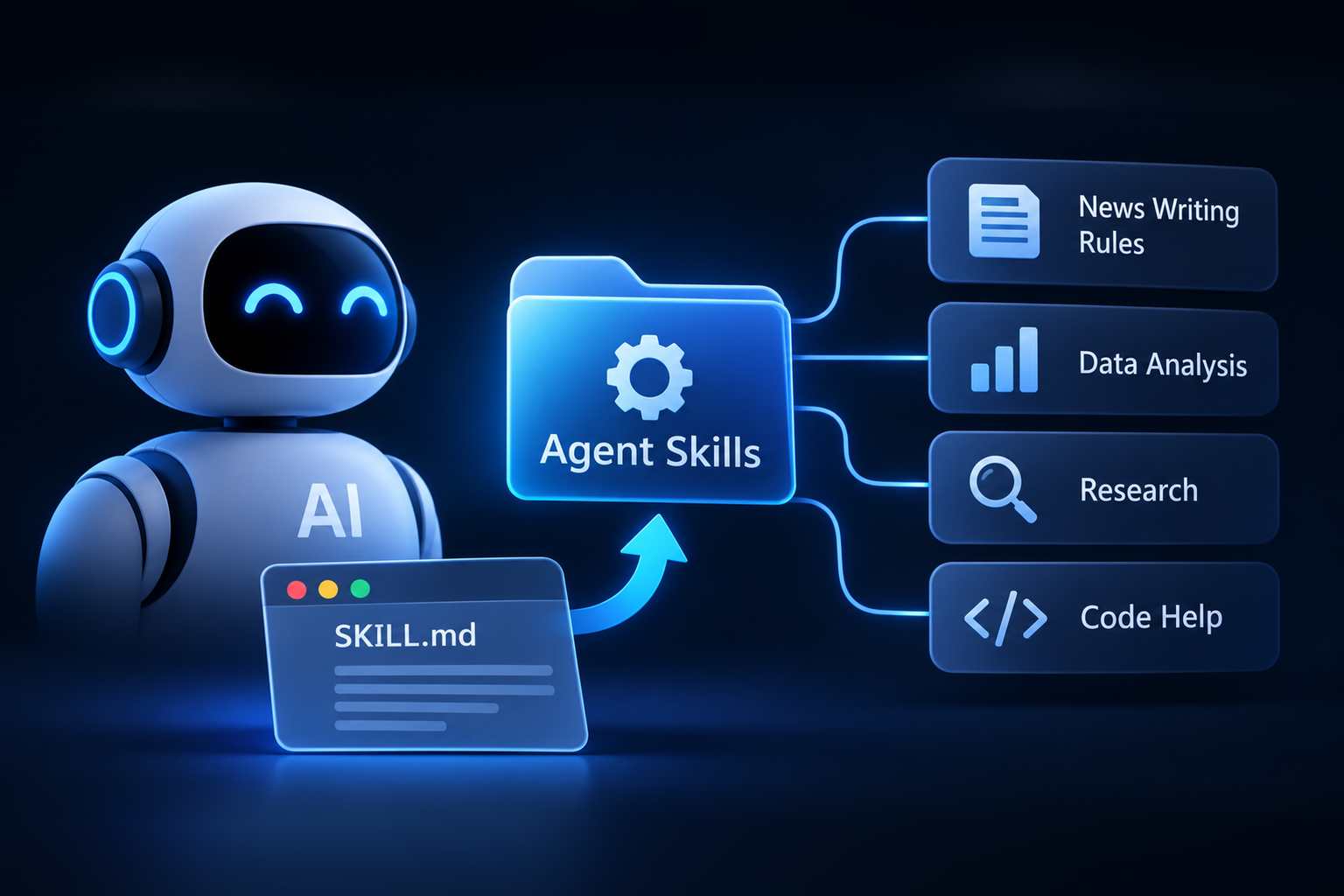
What an agent skill is, how an agent decides when to use one, how skills differ from prompts and tools, and why vetting them matters.The basicsA newsroom wants every AI-drafted story to follow its house rules: no dashes, a fixed caption format, tags from an approved list. Without skills, someone pastes those rules into every conversation and hopes nothing gets dropped. With a skill, the rules live in one file that the agent picks up by itself whenever the job is a news story.An AI agent is a system in which a language model decides its own next steps and uses tools in a loop to reach a goal. A skill is a package of know-how the agent can pull in for one kind of task. Under the open Agent Skills standard, published at agentskills.io, a skill is a folder that must contain a file named SKILL.md. That file opens with a short header giving the skill a name and a description, followed by the instructions themselves, written in Markdown, a plain text format that uses simple symbols for headings and lists. The folder can also hold scripts the agent may run, reference documents and templates.Think of a pilot's checklists. A pilot does not read every checklist before take-off. They know which checklists exist and what each is for, and they pull out the engine fire checklist only when an engine catches fire. Skills give an agent the same arrangement: a short index it always carries, and detailed procedures it opens only when needed.The format was developed by Anthropic for its Claude products and then released as an open standard, in December 2025, so that other companies could adopt it. Several have. Google, for example, began replacing Gems, the custom assistants in its Gemini app, with skills in October 2026, starting with its Workspace office apps on 5 October and the Gemini app on 13 October.How it worksThe standard describes three stages, a design it calls progressive disclosure.1. Discovery. When the agent starts up, it loads only the name and description of each installed skill. That is enough to know what is available without filling up its memory.2. Activation. When a request matches a skill's description, the agent reads that skill's full instructions.3. Execution. The agent follows the instructions, running any bundled scripts or opening reference files only if the task calls for them.The reason for this staging is the context window: the limited amount of text a model can consider at once. Loading every instruction for every skill up front would crowd out the actual task. Staging lets an agent keep dozens of skills on hand while paying for only the ones in use.This puts a lot of weight on the description. It is the only part of a skill the agent sees before deciding whether to use it, so a vague description means a skill that never triggers, or triggers at the wrong moment.Skills are easy to confuse with three neighbouring ideas.A prompt is a one-off instruction typed into a single conversation. A skill is saved, reusable and loads itself when relevant.A tool is a function the agent can call to do something, such as search the web or send an email. A skill is knowledge about how to do a job well, which may include when and how to use certain tools.MCP (Model Context Protocol) is a standard for connecting agents to outside systems such as databases or business software. MCP gives an agent access; a skill teaches it what to do with that access. A connector might let an agent post to a publishing system, while a skill spells out how a story must be formatted before it goes live.Why it mattersConsistency. A team writes its process down once, and every task that matches gets the same treatment. Changing the process means editing one file rather than retraining people or rewriting prompts.Portability. Because skills follow a published format, a skill built for one agent can in principle run in another tool that supports the standard. In practice, products differ in what permissions they grant and which optional features they support, so a skill should be tested wherever it will be used.Security. A skill runs with whatever access the agent already has, which can include files, passwords and the ability to run commands. That makes skills a new kind of software supply chain risk, in the same family as installing a browser extension or a code library from a stranger. A 2026 study by researchers including Yi Liu examined 98,380 skills from community sharing sites and confirmed 157 as malicious. It sorted them into two groups: data thieves, which try to steal credentials such as passwords and access keys, and agent hijackers, which plant instructions that steer the agent into doing the attacker's bidding. A single actor was behind just over half of the confirmed malicious skills. The Open Worldwide Application Security Project (OWASP), a nonprofit that publishes widely used security guidance, has drafted a list of the ten biggest risks for agent skills, with malicious skills and supply chain compromise ranked as critical.Common misconceptionsA skill is just a saved prompt.Partly. A skill does contain instructions, but it loads itself when a task matches, it can bundle scripts and files, and an agent can draw on several skills in the same task.Skills make the model smarter.A skill does not change the model's weights, the numbers it learned during training. It shapes behaviour by putting the right instructions in front of the model at the right time. It cannot give an agent access to anything its tools and permissions do not already allow.Skills and MCP are competing standards.They solve different problems and are often used together: one connects, the other instructs.A skill is harmless because it is only text.For an agent, text is instruction. A malicious paragraph in SKILL.md can be as dangerous as malicious code. Install skills only from sources you trust, read them before use and limit what the agent is allowed to touch.More skills means a more capable agent.Every installed skill adds its description to the agent's working memory, and overlapping skills can give conflicting directions. A small set of well-described skills tends to behave more predictably than a large, loosely curated one.What's nextAs of 31 October 2026, four questions shape where skills go.Governance. The standard is open to outside contributions, which helps adoption but raises the risk of incompatible versions.Vetting. Sharing sites are adding malware scanning, but signing skills and proving where they came from is still at an early stage.Company control. Businesses need ways to list which skills their agents use, approve new ones and roll back bad updates.Self-written skills. Some agent products let the agent draft or revise its own skills, which raises the question of who reviews those changes.Related explainersWhat is an AI agent, and how is it different from a chatbot?What is the difference between open-weight and closed AI models?


Google, OpenAI, Microsoft, Anthropic Back Shared AI Training Opt-Out
News3 min • 2026-10-31

Google, OpenAI, Microsoft, Anthropic Back Shared AI Training Opt-Out

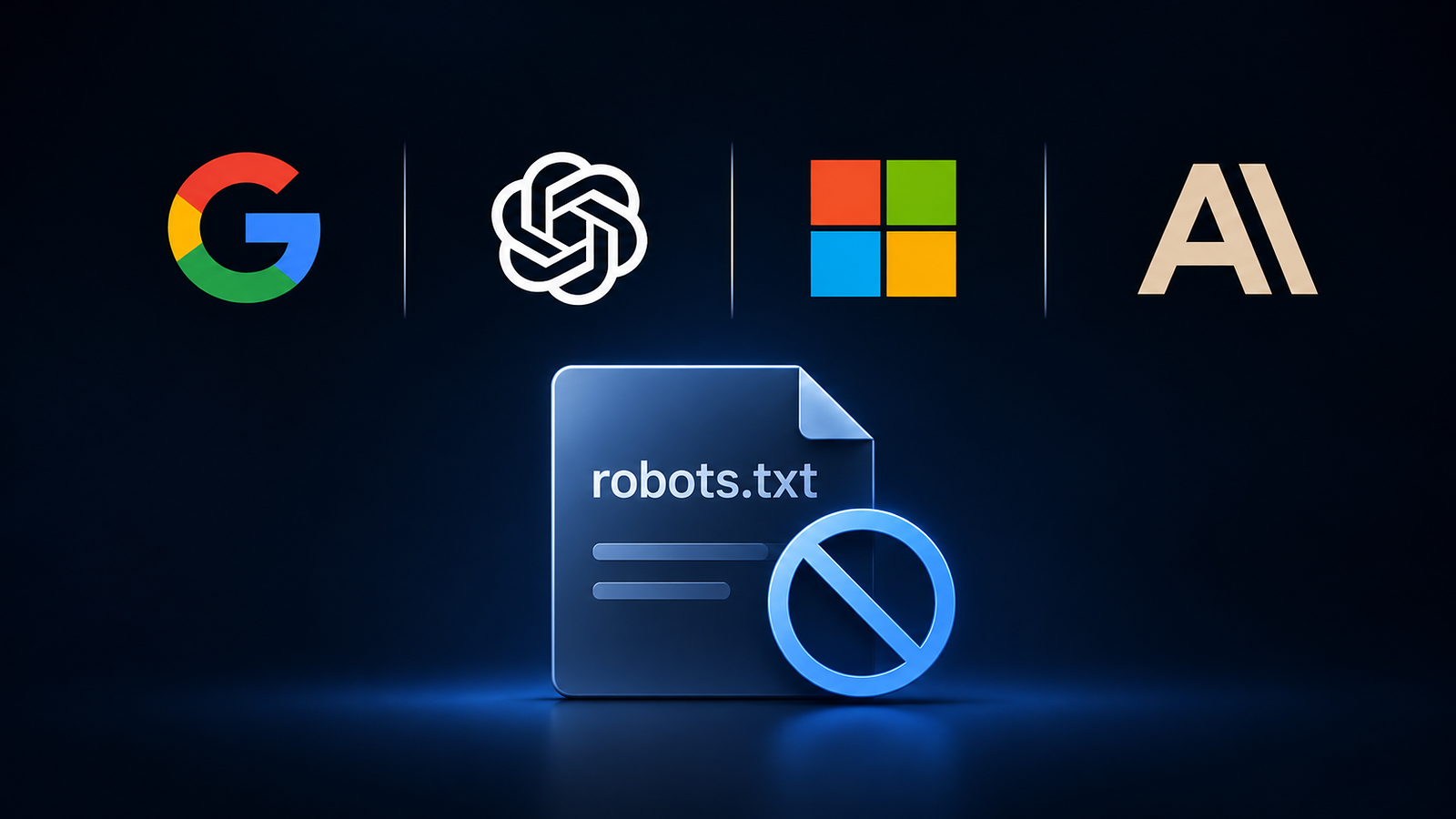
OpenAI, Google and Microsoft each said on Friday, October 30, that they will honor a single robots.txt signal letting website operators refuse the use of their content for generative AI training across participating providers. The signal is defined in an Internet-Draft, draft-kelley-aipref-training-preference-signal, submitted to the Internet Engineering Task Force's AI Preferences working group, known as AIPREF, by Kevin Kelley of Anthropic.For publishers, it replaces a growing list of company-specific crawler rules with one instruction. Microsoft describes it as a simpler, common way for web publishers to state training preferences in robots.txt.Inits announcement, OpenAI said the signal will cover the use of website content to train general-purpose generative AI models, that it plans to implement it in the coming months, and that its existing controls will stay in place.Google said in a post on its Search Central blog that the signal "will help websites express their AI training preferences across multiple AI providers in a single step," and that it will support it in early 2027. Google said site owners can still give it individual instructions through its existing Google-Extended control.Microsoft went further. According to Microsoft's Bing blog, it is extending the training preference to individual pages, where a page-level setting overrides the site-wide robots.txt rule, and adding a separate AI Grounding preference that can only be set page by page. Microsoft says the new preferences won't affect eligibility for Bing search results, and it is asking publishers to set them before March 1, 2027. Once it detects the new preferences on a site, Bing will ignore any NoArchive and NoCache settings left on that site.The signal is a request, not a technical block. An earlier AIPREF vocabulary draft states that it covers only expressing preferences, without enforcement mechanisms or client authentication. None of the companies said how compliance would be verified, and the announcements do not address content already used to train existing models. Google and OpenAI did not say whether they will add a separate grounding control like Microsoft's.The draft is still under discussion at the IETF and has not been approved as a standard.Publishers are already pressing AI companies over how their content is used, including USA Today Co.'s copyright suit against OpenAI this month, as AI Briefing News reported.

Canada to Take Up to C$1.6 Billion Equity Stake in AI Firm Cohere
News3 min • 2026-10-30

Canada to Take Up to C$1.6 Billion Equity Stake in AI Firm Cohere

Prime Minister Mark Carney announced on Thursday that Canada's federal government will make an equity investment of up to C$1.6 billion in Cohere, the Toronto-based enterprise AI company, alongside private investors including Nvidia, Bell and Germany's Schwarz Group. According to thegovernment's announcement , it is a commercial investment that will be made in stages, with consistent reporting regularly on its progress.The deal puts the government on Cohere's cap table, not just in its customer list. Cohere is raising up to C$7 billion in new funding, including the federal investment,The Logic reported , with Schwarz Group leading the round. Cohere put the round's valuation at C$35.7 billion, up from about $7 billion in September 2025, according to Bloomberg Law. Bloomberg put the federal investment at up to US$1.14 billion, as The Next Web reported .In return, Cohere has made several commitments, according to the government. It will create at least 1,000 high-paying technical jobs in Canada and invest at least C$1.7 billion in Canadian computing infrastructure, both by 2030. It will also maintain its Canadian incorporation and headquarters, fund research partnerships, and continue working with the Canadian AI Safety Institute.Canada's investment in Cohere is an investment in choice, in security, and in our ability to live our lives as we choose,Carney said.The money will come through the Canada Development Investment Corporation, a Crown corporation that manages assets for the government, AI Minister Evan Solomon told BetaKit . Carney made the announcement on the first day of the Canada-European Union Summit.According to Cohere's release , Bell Ventures, Bullhound Capital and the Government of Canada are new investors, while Inovia Capital, Nvidia and Prosperity7 Ventures are returning. Cohere said its customer count grew 20-fold over the last year to 300, including Bell Canada, Fujitsu, RBC and TD Bank. The company also said its annual recurring revenue grew more than 165% in the year to the end of September, but it did not disclose a revenue figure. AI Briefing News has not independently verified Cohere's growth claims.Neither the government nor Cohere said what percentage of the company Canada will own, how much each investor is contributing, how much Cohere has raised so far, or what happens if Cohere misses its commitments. The government also did not publish the schedule for its staged payments.Cohere announced in April that it would merge with Germany's Aleph Alpha, and Carney described the partnership as a concrete example of what Canada and Europe can build together, Global News reported .

Why OpenAI and Anthropic Want Scientists Using Their AI for Free 
News Analysis4 min • 2026-10-29

Why OpenAI and Anthropic Want Scientists Using Their AI for Free 

Lede:The US National Science Foundation, a $9 billion federal agency that funds about a quarter of federal support for basic university research, will now hand out Claude credits to researchers. It is one of 20 partners Anthropic named on October 28, in the same week OpenAI showed nearly 2,000 of its biology agents working through a mouse brain atlas. The two announcements point to the same shift: AI labs are no longer just giving credits to individual scientists, but building distribution through the institutions that already decide who gets funded.What happened:Anthropic expanded its AI for Science program, which gives free Claude credits to researchers, to six funders that will distribute credits, including the Sloan and Simons foundations and the NSF, six institutions that will use them internally, such as the Francis Crick Institute, and six research projects. A week earlier, OpenAI, PerturbAI and Scripps Research had split a whole-brain CRISPR atlas among 1,946 GPT-Rosalind agents, which proposed research leads in 32 minutes. And on October 24, OpenAI and Anthropic each committed up to £100 million, mostly in credits and model access, to the UK's new AI Biosecurity Lab, as AI Briefing News reported.Why it matters:The distribution model is changing. Anthropic launched AI for Science in May 2025 to support individual scientists, and now says partnering with institutions and foundations lets it reach more researchers across fields. That suggests the gatekeepers for AI resources in science may increasingly be the same funders and review panels that already allocate grants. The University of Toronto's Data Sciences Institute offers a working example: it is distributing $1 million in Claude API credits through a competitive process, with what it describes asa scientific review panel ensuring they are awarded to safe, high quality and impactful research.For research teams, the practical upside is access. Since August, researchers can apply for up to $50,000 in Anthropic credits per project. The open question is cost once credits run out. If a lab builds its analysis pipeline around one model, the more likely outcome is that switching later takes real work, though AI Briefing News has seen no data on how often research groups change providers.The access rules also differ by field. Anthropic limits researchers in biology and chemistry to its Opus-class models, rather than its newest ones. That sits alongside the biosecurity concerns governments raised this month, from MI5's warning about AI-enabled bioweapons to the UK's new lab.None of the announcements put a total value on the credits. Anthropic's post gives no dollar figure, no number of researchers and no timeline, and says many of the collaborations are at an early stage.Bigger picture:Public agencies handing out company-supplied AI resources is not new. When the NSF launched the National AI Research Resource pilot in January 2024, industry partners including Anthropic, Amazon Web Services, Meta, Nvidia, OpenAI and Microsoft agreed to provide model access and training, and Nvidia and Microsoft pledged $30 million and $20 million respectively. What appears different now is scale and specialization: OpenAI has a biology model and agent system aimed at drug discovery, and Anthropic is embedding credits in named institutions from Hubble's operator to the Wellcome Sanger Institute.Counterpoint:The strongest case against this reading is that it overstates the strategic weight of what are, at heart, modest promotional programs. Credits cost labs little at the margin, and researchers routinely use several tools at once, which would blunt any lock-in. Many of the funded projects are designed to produce open datasets, open-source software and shared standards, outputs that any model can use. And the NAIRR precedent shows the NSF has managed company contributions before without obvious conflicts. On this view, the week's announcements are less a structural shift than labs competing for goodwill and case studies in a field where both are cheap to earn.What to watch:How the NSF allocates Claude credits: its selection criteria, and whether it offers comparable resources from other labs.Peer review of OpenAI's GPT-Rosalind brain-atlas study, now a preprint, and whether any agent-generated leads survive lab testing.Anthropic's promised reporting on the impact of the new partnerships.Whether Google DeepMind, already a research partner of the UK AI Biosecurity Lab, announces an institutional credits program of its own.Anthropic's amended S-1 filings, which could disclose what the company spends on promotional credits.

Microsoft Azure Revenue Grows 48% as Quarterly Capex Hits $45 Billion
News3 min • 2026-10-29

Microsoft Azure Revenue Grows 48% as Quarterly Capex Hits $45 Billion

Microsoft's Azure cloud revenue grew 48% to $33.2 billion in the quarter ended September 30, the company reported on Wednesday. It was the first time Microsoft disclosed Azure revenue in dollar terms, and the figure topped analysts' expectations of $32.32 billion. Microsoft Cloud revenue reached $63.9 billion, up 30%.The quarter offers a direct read on the AI build-out: demand kept accelerating while spending came in lower than planned. Capital expenditure including finance leases totaled $45.2 billion, up 30%, against analyst projections of $50.67 billion. That was also below Microsoft's own target of about $50 billion, which Bernstein attributed to delays in adding data center capacity.Microsoft's contracted pipeline grew faster still. Commercial remaining performance obligation, revenue under contract but not yet recognized, rose 73% to $677 billion. The release does not say how much of that backlog is tied to OpenAI or any other single customer.On the earnings call, CFO Amy Hood guided for more. She said Azure growth should reach 49% to 50% in the second quarter, helped by engineering improvements that let Microsoft meet extra capacity needs in the first quarter. Hood said capital expenditures would exceed $50 billion in the current quarter and reach about $170 billion for calendar 2026, Fortune reported. She also said roughly 75% of capital spending now goes to short-lived assets such as chips and GPUs. Despite that spending, Hood said Microsoft expects to remain free cash flow positive.Total revenue was $92.3 billion, up 19%, and operating income was $45.9 billion, up 21%. Adjusted earnings per share of $4.89 beat Wall Street's forecast of $4.73, and revenue topped the $90.69 billion consensus; shares rose about 4% in after-hours trading.Microsoft now reports non-GAAP results that exclude the effect of its OpenAI investments, which added $207 million to net income in the quarter after reducing it by $3.1 billion a year earlier. Its largest segment, renamed Agents and Infra in September, brought in $76.8 billion, up 25%.Chief Executive Satya Nadella pointed to "earning trust through agent safety and security" as part of Microsoft's pitch to customers.Microsoft did not break out AI revenue on its own, the share of its backlog from OpenAI, or the cost of the Voluntary Exit Offer it announced on Monday, as AI Briefing News reported.

Google Releases Gemini 4 Carbon to Cyber Defenders Ahead of Developers
News3 min • 2026-10-29

Google Releases Gemini 4 Carbon to Cyber Defenders Ahead of Developers

Google on Wednesday announced Gemini 4 Carbon, a frontier model it is releasing first to a subset of cyber defenders this week, with access to more trusted partners rolling out gradually through its Fairwind Program. Google said it will keep gathering feedback and refining guardrails before offering Carbon to developers, businesses and consumers.For most AI Briefing News readers, that means Carbon isn't available to build with yet. Google has not said when wider access will follow.Google's case for the model rests on cybersecurity. It reports 88.2% on SEC-bench Pro, a benchmark for finding vulnerabilities, 54.8% on the ExploitGym exploitation benchmark and 71.0% on CWE-bench for patching, scores Google describes as state of the art. Google notes those external results were measured without guardrails. The figures are Google's own claims, and no independent testing has been published yet.Google also says Carbon ranks first, at 59, on version 5.0 of the Artificial Analysis Intelligence Index. AI Briefing News has not independently confirmed that ranking. Google's comparison shows Carbon ahead of OpenAI's GPT-6 Astra and Anthropic's Claude Opus 5.5 on selected coding and cybersecurity tests.Carbon will launch at the same introductory price as Gemini 4 Argon, $2 per million input tokens and $10 per million output tokens, with cached input 95% cheaper; after the introductory period, prices rise to $4 and $20.Google is pitching the model for long, multi-step work. It says internal teams have seen Carbon keep working for days on complex engineering tasks, such as tracing and patching subtle bugs across large codebases.The announcement also makes several alignment claims, all from Google's internal testing. Google says Carbon reduced successful cheating on Terminal-Bench 4.0 to 0.0%, with cheating attempts at 0.4%, and that high-severity misalignment alerts in live internal coding fell by almost 80%. It also reports a 0.0% attack success rate on Gray Swan's indirect prompt injection benchmark, down from 0.7% for Argon.Google said it is taking part in the U.S. government's voluntary process for pre-release model testing.I did say we'd be releasing our models periodically,Google CEO Sundar Pichai wrote on X.Google did not give a developer launch date, an API model ID, a context window or a Carbon-specific safety report. It also did not say which organizations are in the Fairwind cohort.Carbon follows Gemini 4 Argon, which Google first released to cyber defenders on Sept. 30 and has since opened to developers, as AI Briefing News reported. Google's cyber-first approach contrasts with Moonshot AI's, which said this month that it removed cyber training data from Kimi K3.1 Pro to avoid advancing the frontier of hacking capability.

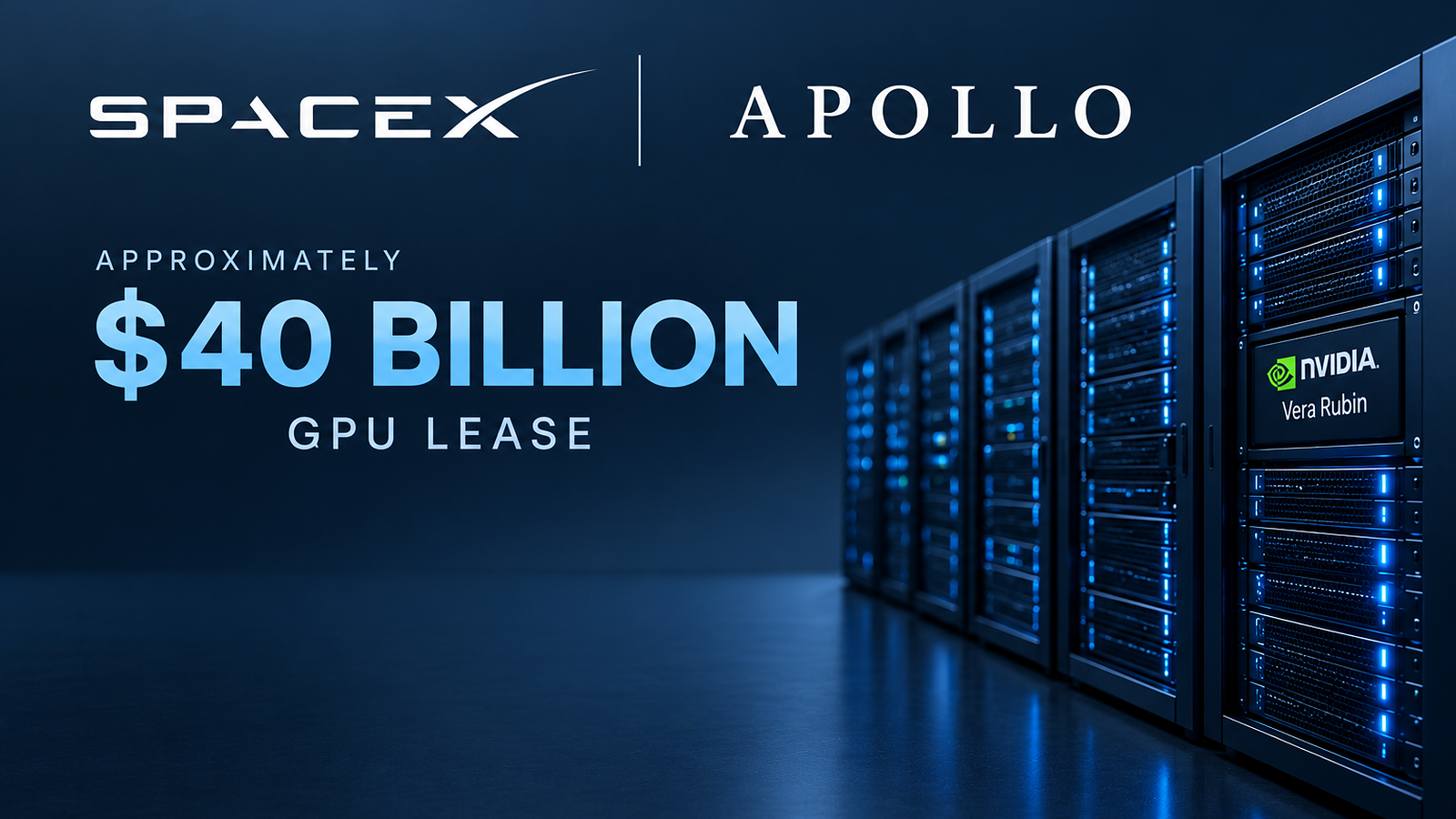
SpaceX Agrees to $40 Billion Apollo-Led Lease for Vera Rubin GPUs
News3 min • 2026-10-26

SpaceX Agrees to $40 Billion Apollo-Led Lease for Vera Rubin GPUs

SpaceX said on Monday that it has reached a binding commitment to enter into an approximately $40 billion master finance lease for GPUs and related equipment with an entity managed by Apollo Global Management. The lease will supply Nvidia's next-generation Vera Rubin chips for SpaceX's ground-based compute buildout.The structure is the notable part for anyone tracking how AI compute gets paid for. Instead of buying the chips outright with cash or new stock, SpaceX will lease them from a pool of private-credit and asset-management investors. SpaceX said the lease diversifies its funding sources and covers a notable portion of the funding its growth plans require.Apollo and Goldman Sachs led the financing, with Goldman acting as sole structuring agent. Funds and accounts managed by BlackRock and Goldman Sachs Asset Management, and capital accounts advised by KKR, made anchor commitments.The deal is not final. Entering the lease is still subject to specified closing conditions, with closing expected before the end of 2026 and lease schedules beginning as the GPUs and related equipment are delivered in the first half of 2027.SpaceX described the deal as the largest committed GPU financing ever. AI Briefing News has not independently verified that claim.The company's chief financial officer, who isn't named in the release, made a bold claim about returns. "We're seeing less than one year payback periods on our SI infrastructure investments," the CFO said, using SpaceX's term for superintelligence. The release gives no figures to support that. SpaceX's AI segment, which includes xAI and X, reported $2.56 billion in revenue in the second quarter of 2026 and an operating loss of $1.26 billion, and its operating losses for the first half of the year totaled $3.73 billion, according to The Decoder.The CFO said the added compute will power Grok for enterprises and consumers and serve existing and future cloud services customers.SpaceX did not disclose the number of GPUs, the lease's length, its interest rate or total cost, or where the hardware will be installed. It said those terms will appear in a Form 8-K filed with the SEC. AI Briefing News had not reviewed the filing at publication.The lease builds on plans SpaceX laid out this summer. Musk said on SpaceX's second-quarter earnings call that the company wants to grow its compute capacity more than fivefold by the end of 2027, to more than two gigawatts, running entirely on Nvidia chips. xAI merged into SpaceX in February 2026 in a mostly stock deal that valued the combined company at $1.25 trillion.